Groq
This provider is an extra of the lfx-bundles metapackage. It is opt-in for both Langflow and standalone LFX installs:
uv pip install "lfx-bundles[<bundle>]"
Replace <bundle> with this page's provider name, for example qdrant.
For a torch-free full Langflow install, run uv pip install "langflow[bundles]".
For standalone LFX with every provider in lfx-bundles, including PyTorch-based providers, run uv pip install "lfx[bundles]".
See Additional bundles for the exact extra name.
Bundles contain custom components that support specific third-party integrations with Langflow.
This page describes the components that are available in the Groq bundle.
For more information, see the Groq documentation.
Groq text generation
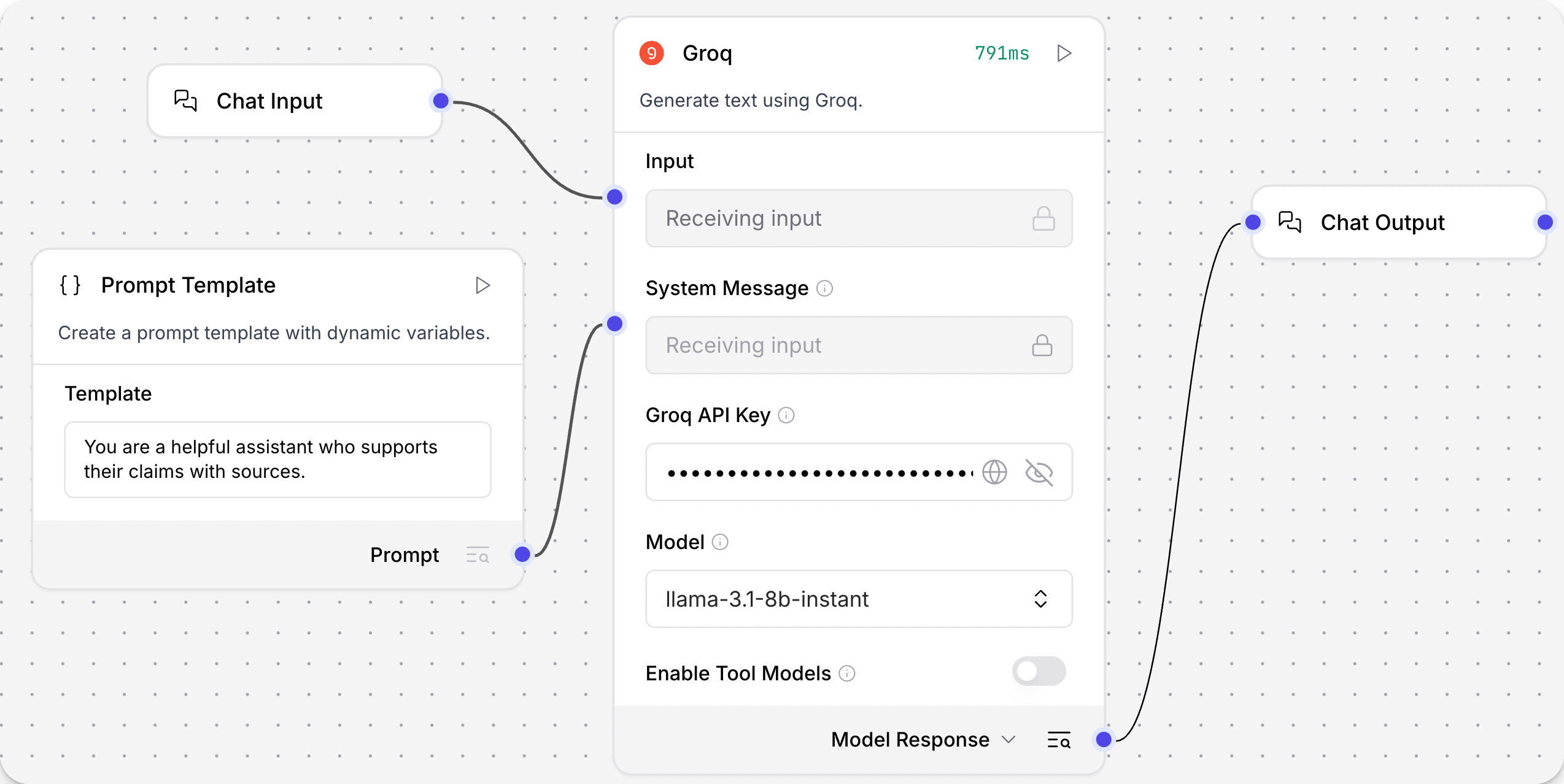
This component generates text using Groq's language models.
It can output either a Model Response (Message) or a Language Model (LanguageModel).
Specifically, the Language Model output is an instance of ChatGroq configured according to the component's parameters.
Use the Language Model output when you want to use a Groq model as the LLM for another LLM-driven component, such as an Agent or Smart Transform component.
For more information, see Language model components.
Groq text generation parameters
| Name | Type | Description |
|---|---|---|
| groq_api_key | SecretString | Your Groq API key. |
| groq_api_base | String | Base URL path for API requests. Default: https://api.groq.com. |
| max_tokens | Integer | The maximum number of tokens to generate. |
| temperature | Float | Controls randomness in the output. Range: [0.0, 1.0]. Default: 0.1. |
| n | Integer | Number of chat completions to generate for each prompt. |
| model_name | String | The name of the Groq model to use. Options are dynamically fetched from the Groq API after entering your API key and URL. To refresh your list of models, click Refresh. |
| tool_mode_enabled | Boolean | If enabled, the component only displays models that work with tools. |
Was this page helpful?